Building momentum for impact
In this edition, we look ahead to COP31, with IIA partnering with the Principles for Responsible Investment (PRI) to convene investors and climate policy leaders. We’ll share the insights from these discussions in our next newsletter.
We also explore what is needed to turn growing investor appetite into greater capital allocation, with our Head of Engagement Michelle Di Fabio examining the pathways needed to scale Australia’s impact investing market.
Alongside this, we spotlight ReLove, a SEDI Grant recipient using funding to strengthen its capabilities and expand its impact, and share an opportunity for not-for-profit leaders through a Stanford Australia Foundation scholarship.
Finally, we highlight the launch of GSG Impact’s Annual Report.
Enjoy this month’s update.
David
David Hetherington, CEO
Impact Investing Australia
IIA and PRI convene investors ahead of COP31
As Australia prepares to co-host COP31, IIA is bringing together investors and key climate policy stakeholders to explore how private capital can help deliver stronger climate finance outcomes across the Indo-Pacific.
In partnership with the PRI, IIA will host two closed-door COP31 Investor Roundtables – in Melbourne on 31 August and Sydney on 10 September. The roundtables build on similar convenings we held ahead of COP30 last year.
The discussions will focus on the investment pipeline, current market constraints and opportunities to mobilise greater private capital, with particular attention to climate adaptation and resilience. They will also provide an opportunity for investors to engage directly with government on the priorities and policy thinking shaping Australia’s COP31 agenda.
The Melbourne roundtable will feature the Hon. Kate Thwaites MP, Special Envoy for Climate Change Adaptation and Resilience, while Dr Chell Lyons, Director, China, Japan and International Finance at the Department of Climate Change, Energy, the Environment and Water, will join the Sydney discussion.
The roundtables are designed to surface practical insights from investors and contribute to the broader conversation on how Australia can help unlock climate finance across the region.
We’ll share key insights and takeaways from both roundtables in our next newsletter.

How institutional capital will scale Australia’s impact investing market
Australia’s impact investing market has surpassed $157 billion in assets under management, reflecting growing participation from superannuation funds, asset managers, foundations, trusts, family offices and private wealth investors. But compared with more than $4 trillion in Australia’s superannuation system, the capital flowing to impact remains a fraction of its potential.
The challenge is increasingly not investor appetite, but the structures and pathways that enable capital to move at scale.
As our Head of Engagement Michelle Di Fabio explores, impact opportunities across affordable housing, climate infrastructure, natural capital and social outcomes finance are growing. For institutional investors, however impact must sit within a credible investment proposition built on risk-adjusted returns, governance, track record and scale.
Policy settings also matter. Removing structural barriers and creating an enabling environment can give investors greater confidence to pursue emerging opportunities while maintaining fiduciary discipline.
Scaling the market will require coordinated action across investors, asset managers, government and market builders – from repeatable investment structures and shared due diligence to stronger policy dialogue and clearer pathways to institutional capital.
The pipeline is here. The appetite is growing. Now, the task is turning that momentum into greater capital allocation.
Read the full story in OnImpact
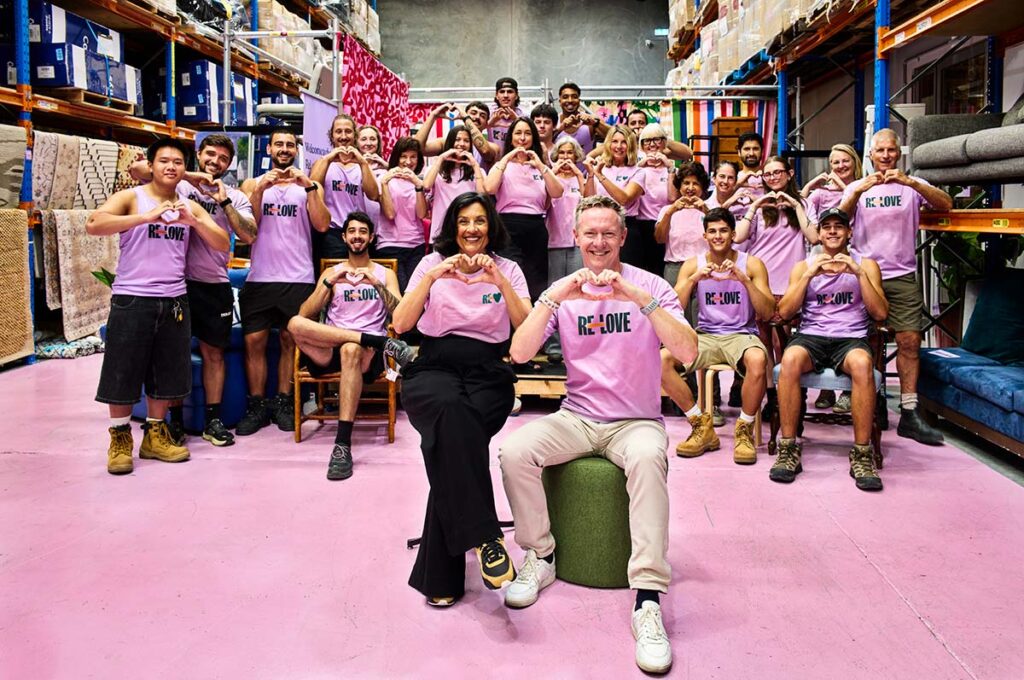
SEDI Grant spotlight: ReLove – helping people rebuild homes and lives
For people experiencing crisis, having a safe and comfortable home can be an important first step towards a fresh start. Social enterprise ReLove is helping make that possible by rescuing quality furniture and homewares and delivering them directly to people who need a helping hand.
ReLove provides families with the essential items they need to make a house a home, while giving people the dignity and choice to select what works for them. ReLove:
- supports around 25 families each week
- has helped furnish the homes of more than 8,900 people
- has provided over $39 million worth of rescued furniture
- has kept more than 6,500 tonnes of furniture out of landfill
A SEDI Grant, administered by IIA, recently helped ReLove strengthen its business capabilities and grow its impact. ReLove used SEDI Grant funding to develop its business plan, create a digital marketing strategy and plan, and upgrade its IT systems.
Our SEDI Grants program supports social enterprises across Australia to grow their businesses, scale their impact and create positive social change. The grants are funded by the Australian Government’s Department of Social Services and support capability-building services in areas such as business consulting, financial services, legal advice and impact measurement.
$25,000 Stanford scholarship for Australian not-for-profit leaders
Applications are now open for the Stanford Australia Foundation’s Not-for-Profit Leadership Scholarship, offering up to $25,000 for a senior leader of an Australian DGR1 not-for-profit to undertake an executive education program at Stanford Graduate School of Business.
Supported by the Dyson Bequest, the scholarship is designed to help purpose-driven leaders strengthen their strategic thinking, gain global perspective and build their capacity to drive social impact.
Applications close 9 October 2026.
International news
GSG Impact releases Annual Report
GSG Impact has released its 2025 Annual Report, reflecting on a year of growth and progress across its global partnership and reinforcing a central message: addressing today’s social, environmental and economic challenges requires more than individual investments. It requires economies that consistently reward positive impact.
Against a backdrop of geopolitical uncertainty, constrained public finances and pressure on philanthropy and development finance, the report highlights the need to mobilise significantly more private capital towards national priorities.
Achievements in 2025 include welcoming new National Partners from Burkina Faso and Indonesia, while strengthening governance, measurement and performance tracking across the network.
The report highlights three strategic priorities:
- strengthening impact ecosystems through a stronger global partnership
- influencing policy to create enabling frameworks for impact economies
- mobilising impact capital for inclusive and climate-aligned growth
As a GSG Impact National Partner and Australia’s representative, IIA is proud to contribute to this global movement and bring an Australian perspective to the shared work of building impact economies.
Read the GSG Impact Annual Report 2025